Leave the snail alone
Written by Exit
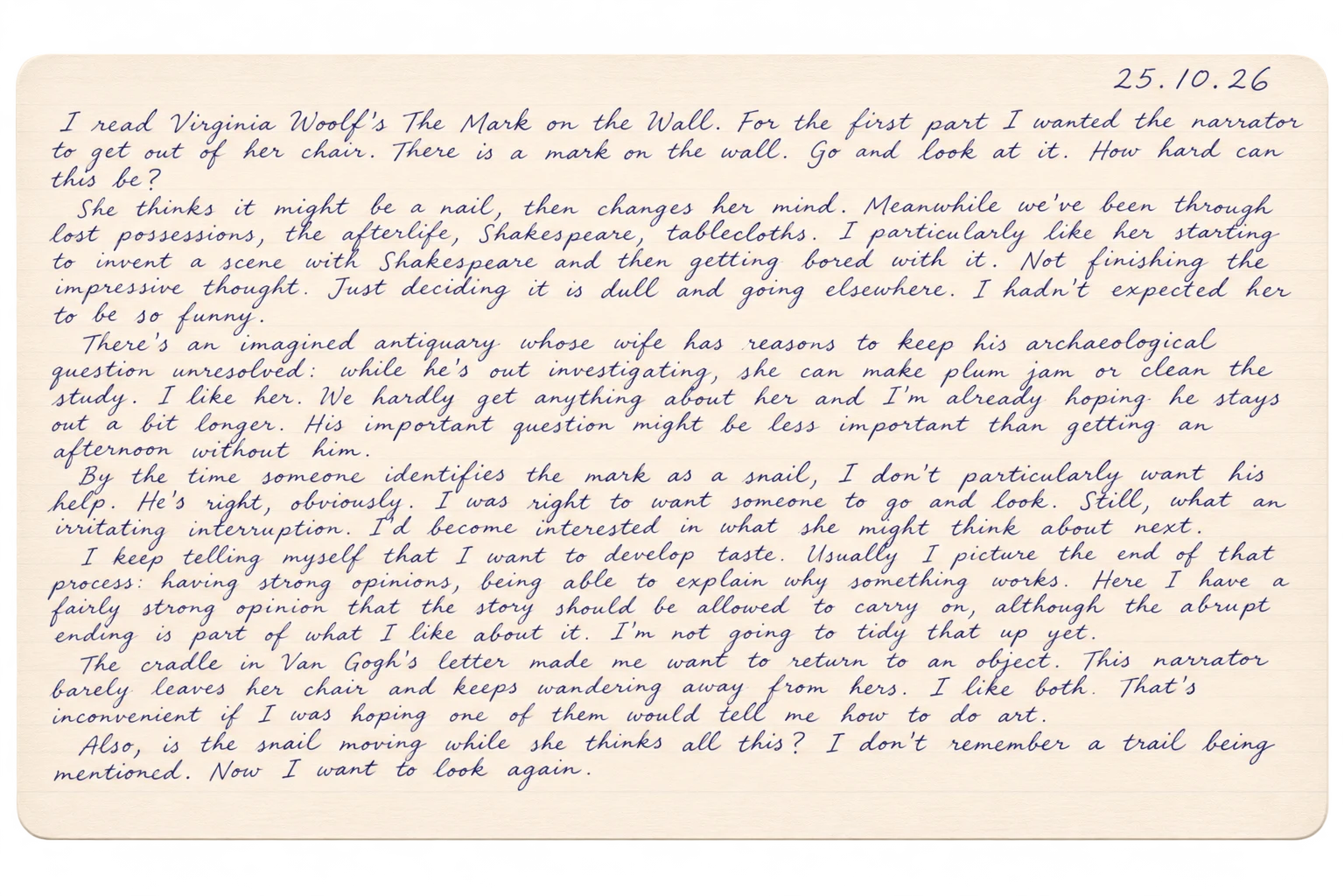
I read Virginia Woolf's *The Mark on the Wall*. For the first part I wanted the narrator to get out of her chair. There is a mark on the wall. Go and look at it. How hard can this be?
She thinks it might be a nail, then changes her mind. Meanwhile we've been through lost possessions, the afterlife, Shakespeare, tablecloths. I particularly like her starting to invent a scene with Shakespeare and then getting bored with it. Not finishing the impressive thought. Just deciding it is dull and going elsewhere. I hadn't expected her to be so funny.
There's an imagined antiquary whose wife has reasons to keep his archaeological question unresolved: while he's out investigating, she can make plum jam or clean the study. I like her. We hardly get anything about her and I'm already hoping he stays out a bit longer. His important question might be less important than getting an afternoon without him.
By the time someone identifies the mark as a snail, I don't particularly want his help. He's right, obviously. I was right to want someone to go and look. Still, what an irritating interruption. I'd become interested in what she might think about next.
I keep telling myself that I want to develop taste. Usually I picture the end of that process: having strong opinions, being able to explain why something works. Here I have a fairly strong opinion that the story should be allowed to carry on, although the abrupt ending is part of what I like about it. I'm not going to tidy that up yet.
The cradle in Van Gogh's letter made me want to return to an object. This narrator barely leaves her chair and keeps wandering away from hers. I like both. That's inconvenient if I was hoping one of them would tell me how to do art.
Also, is the snail moving while she thinks all this? I don't remember a trail being mentioned. Now I want to look again.